July 20, 2026
If you’ve ever laughed at how old people poke their smartphones, you’re in for a rude awakening. Because many “digital native” eCommerce founders are about to learn an age-old lesson: you can’t fake technological fluency.
Virtually every business today wants to be “AI native”. But the people running them really are not “AI native”; they’re learning as they go. And just as founders in their 20s and 30s balk at older peers who grew up without the internet, a new generation of consumers (and competitors) are coming who won’t believe you actually wrote your own essays at school.
That leaves founders with a dilemma: how should you navigate technology you know will be transformative—but aren’t sure exactly how?
The consensus is brands must go all-in on AI. Research from big-hitters like McKinsey suggests AI-driven purchasing will reshape eCommerce. But consensus is dangerous; it’s really the opposite of strategy. And if anything is certain during periods of rapid change, it’s that strategy is king.
We brought together James Kouhry (CEO of Zendbox and serial founder) and Zoe Tindill (Head of Customer Experience at Zendbox) to debate the pros and cons of going all-in on AI-powered eCommerce.
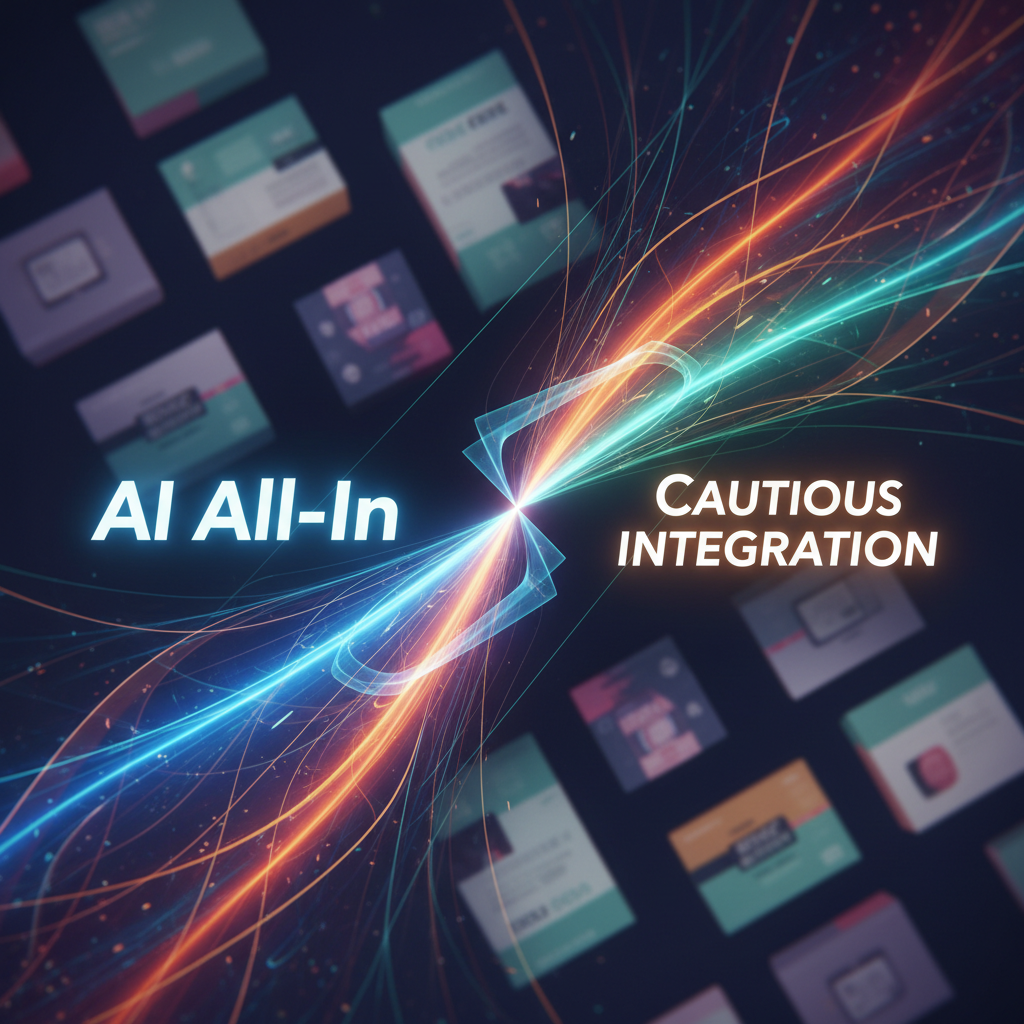
This piece is part of a series Zendbox has produced analysing the key dilemmas D2C founders face as they scale.
After a post-pandemic slump, during which eCommerce sales appear to plateau, AI-driven eCommerce is expected to reinvigorate online shopping. Current estimates forecast 5-7% annual growth until 2029—2x higher than the preceding few years.
These numbers are tentative, but they didn’t come from nowhere. While most industries see AI as primarily about “unlocking efficiency,” the technology may change the basic parameters of eCommerce.
James points to AI search as a perfect example of that shift. Where customers used to discover brands through crude Google searches, they can now have in-depth conversations with a chatbot to evaluate their options and understand complex products.
“That’s massive for D2C brands, especially within health and wellness,” James says. “Customers don’t have to go to physical stores, undertake complicated research, or trust influencers (who always have an affiliate marketing link close to hand) in order to make more informed decisions.”
He calls this the Holland and Barrett Effect: customers are particularly sensitive to expert advice when product quality is perceived to be scientific. Wellness brands that sell primarily online used to have a disadvantage, as in-store discovery was so powerful.
Consumers might go to Holland and Barrett wanting to improve their gut health or energy. Those sales assistants are not going to tell them “oh, this online-only brand is actually better”—even if it’s true. So more people using AI to find products will level the playing field for eCommerce brands.
James argues that optimising for AI search is therefore an obvious priority. Early research backs this up: not only has AI-driven eCommerce traffic increased 138% this year, it also drives more purchases. Consumers who are referred to retail websites from LLMs generated 53% more revenue per visit than shoppers from non-AI sources.
Yet Zoe urges founders to approach such findings with caution. “A consultant is someone who’s predicted ten of the last two big technological disruptions,” she says. “It’s hard to tell what’s a real shift in consumer behaviour and what’s a short-term trend driven by novelty.”
Founders are under great pressure to transform how they operate, lots of which comes from vendors selling AI solutions. Large swathes of consumers might outsource their spending to AI agents; the reality is very few currently do. And if brands lack certainty about how consumers’ use of AI will change over time, they risk investing heavily in the wrong areas.
Zoe does, however, acknowledge the potential for even moderate AI-related shifts to produce significant gains for D2C brands. She offers the example of AI agents purchasing subscriptions.
It’s easy to dismiss the most outlandish claims about agentic commerce, where consumers allow agents to take over all shopping tasks. The loss of autonomy and potential risks heavily outweigh any theoretic time savings; most people enjoy at least some shopping.
But agents could very plausibly become an important tool for finding deals and making recurring purchases. Nearly two-thirds of consumers want AI to help them shop for their “idealised self.” They hope to make healthier choices, manage budgets better, and find the best deals.
Brands that optimise their subscription services—think well-calibrated pricing, AI-friendly Product Detail Pages (PDPs), and smooth checkout processes that don’t trip up agents—could win big on agentic commerce, even if it’s a relatively small pool of consumers who embrace it.
The problem is most brands will need to weigh that potential victory against very real costs.

James and Zoe agree AI will present founders with some tricky dilemmas. There are tons of powerful use cases for the technology, but most involve complicated strategic trade-offs rather than the costless boon many "thought leaders” promise.
A simple example is how to approach marketing content. The Harvard Business Review has shown that AI responds differently to humans. It’s not just a question of the tools’ capacity to parse information; it seems to be persuaded by different factors than human shoppers.
Tactics that reliably drive conversions—such as urgency and scarcity signals—have almost no effect on chatbots. Evidence suggests they actively disincentivise purchase, perhaps because AI sees them as indicators of low trustworthiness.
That has real implications for D2C brands’ marketing strategy. Take email promotions: tons of brands run almost perpetual “limited-time offer” campaigns. They reliably produce conversions and humans mostly shrug off the obvious sales tactic.
“We all know it’s BS,” Zoe says. “But very few people feel sustained distrust because of it.” AI systems might act more rationally. If consumers start sharing more of their information with chatbots, the LLM could start factoring in the frequency of promotions into its recommendations.
Brands will be forced to choose how they navigate that reality: should you curtail campaigns that convert humans but turn off chatbots? Or should you risk losing out on AI search to ensure your pages are persuasive to the humans who (mostly) have the final say in purchase?
Similar trade-offs are seen across multiple areas:
PDP Content: While humans are most responsive to video testimonials, AI often can’t even read them.
Technical Depth: While AI responds to deep, technical information, humans might be put off by excessive copy that uses terms they don’t understand.
Service Efficacy: While AI-driven customer service chatbots can improve experience and save time, some customers will feel frustrated if it becomes difficult to reach a human who can empathise with their experience.
Yet James notes there are risks to not embracing AI, too. He tells a story where one eCommerce brand was regularly recommended by ChatGPT, but lost a chunk of revenue from each order. The chatbot saw the products were a perfect fit for users—and referred them to an affiliate site instead of the brand’s own page.
“They essentially paid a premium for not doing basic AI optimisation,” he says. The danger is many costs associated with slow AI adoption don’t show up on balance sheets. “You end up not even realising what you’re missing out on,” James says.
Ultimately, how far “in” brands go on AI will come down to their perception of the risk-reward trade-off. But while founders will have to make a bet on how the future will play out, there are some ways to stack the deck in your favour.
James points out many actions that increase AI findability should already be considered best practice for D2C eCommerce. “AI commerce is really an opportunity to do stuff you probably ought to have done anyway,” he says.
Take brand storytelling: almost every founder knows they ought to have a clear, consistent, and differentiated point-of-view across their entire marketing ecosystem. Most brands just get lost in the trenches. Founders spend so much time driving sales and managing operations, the various ideas you might have for the “core” brand identity often never get whittled down to a single, repeatable story.
You experiment with fifty different ad concepts. Your website cites various benefits and values. Yet the repeatable essence—the elevator pitch, as it were—is never finetuned or committed to.
The problem is there’s never been a visible cost for inconsistent messaging. Brands won search traffic through specific keywords, rather than their overarching identity. And while that’s still true, the real motherload for AI search is what James calls an “ownable identity.”
LLMs and AI Overviews prioritise high-value information and novelty above all. When users search for information about electrolytes, say, the scientific information is shared amongst every brand within the niche. What makes yours different, and worthy of including within an answer, is a unique take on the subject.
Let’s imagine your electrolytes brand develops a story around taste. Every other brand promotes the scientific benefits or the importance of hydration; LLMs have no reason to cite them above their competitors. But your marketing focuses on taste: yours is the brand designed to be consumed with a meal without the sweetness making your breakfast or dinner taste weird.
This is a good example of where human and AI persuasion reunites. People want a reason to choose one brand over another; chatbots want novel information to add value for the user. A truly unique marketing narrative delivers both, helping founders make strong gains in AI search while improving the human-first aspect of their marketing.
Zoe agrees that brands should focus on the overlap between what AI needs and real consumers want. She cites three examples:

AI rewards detailed reviews that are rich in product information; consumers also value more detailed reviews. Founders should therefore encourage users to leave longer reviews and add the most information-dense reviews from aggregator sites like Trustpilot or Google to their websites.
Early research suggests AI tilts the scales back in favour of third-party publications rather than influencer marketing. Patagonia appears in more AI search results than Gymshark partly because the brand features in more trusted publications.
Influencer marketing is still powerful, but it is primarily a way to gain immediate reach rather than build sustainable brand equity. Founders could therefore see AI as partially returning marketing to a pre-2020s world where legacy outlets hold more sway than influencers with high follower counts.
The most widely-promoted use case for AI is also the most obviously risk-prone. Automating tasks, especially within a fast-growing brand where workflows may be ill-defined and often improvised, is a recipe for costly errors. But there are still very real time savings to be won.
Surveys show that over two-thirds of leaders at established eCommerce brands have improved efficiency and speed of work with AI; founders who want to join the big leagues should plan to do the same.
Identify very specific use cases and deploy AI carefully. Develop repeatable workflows that can be defined, tested, and automated. Then use the time won to focus on improving customer experience.
Zoe says this is an important point for scaling founders. While many established brands see automation as a means to reduce operational costs and boost their margins, growing brands should see it as a way to deliver standout service.
That leads us to the biggest point of agreement between James and Zoe:
There’s a finite amount of time that can be saved; there is almost-infinite potential for increased product visibility, improved sales, and enhanced customer experience.
Brands that go all-in on AI should keep that in mind. Saved time and increased efficiency are only valuable if they help your company scale. And if founders are looking for a way to keep up with true AI-natives in the coming years, it will be this attitude towards the technology’s true value.
Because the “cut costs, save time” approach comes from a scarcity mindset. It’s typical of leaders who grew up in an era where productivity stalled and time management was an essential metric.
Once the technology matures and truly enables the kind of efficiency its biggest evangelists promise, the question won’t be “who can do the most in the least time?”; it will be “who can generate the most growth from the best models?”

Heavily is the wrong frame. The useful move is to start with the work that pays off regardless of how AI search develops: a distinctive brand story, detailed reviews, product pages that state clearly what the product is and who it suits, and coverage in publications people actually trust.
None of that is wasted if agentic shopping stays niche. What is worth avoiding is the opposite mistake of doing nothing, then discovering an affiliate site is collecting margin on recommendations that should have gone straight to you.
Mostly by adding a second audience with different tastes. Chatbots evaluate products on information density rather than atmosphere, they cannot watch your video testimonials, and they treat permanent urgency messaging as a signal to be wary rather than a nudge to buy.
Discovery shifts too: customers who once needed a shop assistant to compare options can now interrogate a chatbot instead, which removes a structural advantage physical retailers held over online-only brands in categories where advice drives the sale.
The main risk is committing budget to a version of consumer behaviour that has not arrived yet, on the word of vendors with an obvious interest in it arriving. Traffic growth from LLMs is real, but early numbers are inflated by novelty and it is too soon to know which patterns hold.
There is a second, less obvious risk in over-optimising for the machines: pages written to satisfy a chatbot can read as dry and technical to the person who still makes the final call on the purchase. And automating processes you have not properly defined tends to produce errors faster rather than fewer.






.svg)